Friday, February 1, 2013
Festival de Alasitas
After a few days of catching our breath (literally) in La Paz, Bolivia, we made our way to Copacabana, a 12,533-foot-high town on the southern shore of Lake Titicaca. At nearly two-and-a-half miles above sea level, we found ourselves wearing out our alpaca sweaters, yet lathering sunblock on our exposed hands and faces, as the sun marks its territory on all uncovered skin.
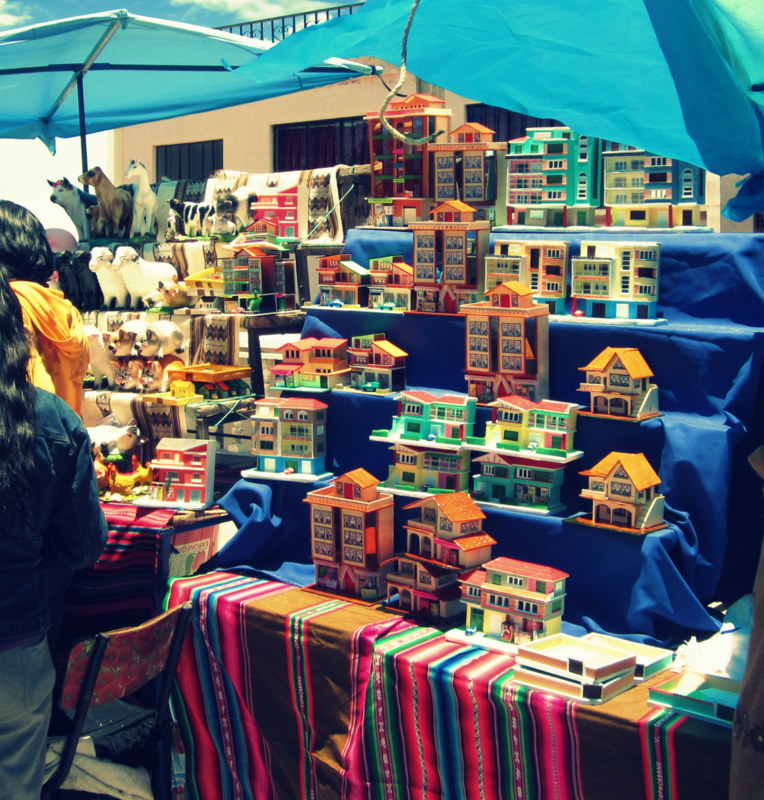
Copacabana has for centuries, and continues to be, the spot for religious pilgrimage and parties. We encountered some of both during the Festival de Alasitas. This is a festival of abundance, fertility, happiness, and prosperity. Ironically, Alasitas is an indigenous Aymara word meaning "buy me," which actually makes sense when you understand the custom.
On January 24th, the streets of Copacabana are laden with vendors selling miniature items: mini money, mini houses, mini cars, etc. The traditions is to buy for yourself or a loved one whatever it is you would like to manifest in life. As part of the celebration, vendors also sell miniature cakes and breads.
I was surprised to see an abundance of mini plastic poultry (there didn't seem to be a shortage of the real thing), until I found out that chickens, roosters, and chicks are used to represent relationships, family, and children. Who knew?
The festival is presided over by Ekeko, the Aymara god of abundance himself, or at least his doll-sized representation, a chubby little cigar-chewing figurine. After people have chosen their items, which include mini diplomas and divorce certificates, they have them blessed by one of the many Yatiris (priest/medicine man)lined up in the middle of the market who passes them over a smoking pot of palo santo.
This day is also a popular time to climb the old stone steps and pray for good fortune at the stations of the cross, which lead to the summit of Cerro Calvario, overlooking the lake. The climb is about 150 meters up from the town, which is serious business at altitude.
As we watched the sun set behind the mountains towards Peru, abundance was definitely in the air.
Thursday, January 24, 2013
Return to Big Sky Country
I got up at 6am this morning and stepped out of the cave of a bedroom in my Paraguayan mom, Marina's, house in time to see the rising sun burning red through the trees. Marina's husband, Concepcion, was just finishing breakfast and on his way out to the field. Marina, my sister, Daisi, and I sat just outside the kitchen and proceeded to drink mate for the next hour and a half, while dogs, chickens, and piglets scurried around us. We chat about everything—relationships, religion, beekeeping, why the sky is bigger here. Then they are off in a flurry of activity, kicking up dust as they sweep the yard, picking up the dozens of fallen mangoes, feeding the animals, washing clothes and dishes, carrying small children to and fro. It feels good to be back.
“He was still too young to know that the heart's memory eliminates the bad and magnifies the good, and that thanks to this artifice we manage to endure the burden of the past. But when he stood at the railing of the ship and saw the white promontory of the colonial district again, the motionless buzzards on the roofs, the washing of the poor hung out to dry on the balconies, only then did he understand to what extent he had been an easy victim to the charitable deceptions of nostalgia.” --Gabriel Garcia Marquez (Love in the Time of Cholera)Ryan and I left Florida January 6th, both sick and sleep deprived. As the city lights of Asuncion grew bigger and rose up to meet the plane as we made our final decent into Paraguay I felt exhausted, but exhilarated with thoughts of my first arrival here four years prior and all that was to lay ahead. Just another victim of nostalgia. As the plane taxied into the gate, no time was wasted as passengers lined up in the aisles and then proceeded to file out, feigning (or not) oblivion as I attempted to stand up. Then everyone hovered around the tiny baggage carousel so closely that we had to crane our necks from the back to watch for our bags and then watch people try to maneuver their luggage through the stagnant travelers. How did I forgot the lack of, what I call common, courtesy that gnawed at me for two years? We exited the airport around midnight into the oppressive city heat and proceeded to take an overpriced cab to our hotel. To recuperate, we splurged on an air-conditioned room in a nice hotel I used to stay in on visits to the Peace Corps office. We visited the office, the downtown area, and then we couch-surfed with a Paraguayan for a night before leaving the city. The first day or so in Paraguay was filled with doubts about my purpose here. Why did I return to this hot, dusty place with gigantic, biting bugs, and a marked lack of customer service and pedestrian rights. Still, it felt somewhat gratifying to embrace the heat and re-explore my old stomping grounds. Arroyo Moroti, however, was where I wanted to be. On day three we made the journey into the yerba mate capital. After two years, things look pretty much the same. Trees and children have gotten taller. There are also more motos and cars. When I first got here four years ago it was a rare thing to see a car drive down these red, sandy roads. I know it is unfair of me to want Paraguay to remain frozen in time, while people here are working hard to improve their lives with first-world machines. It is debatable whether or not cell phones, tractors, and motorcycles are improvements. For some, they are conveniences that have allowed more work to be done with less effort, granted access to education, and created positive change in general. For others, these conveniences are merely distractions and money pits. The other day I asked Daisi about going to swim in the Tebicuary, like I used to do almost every day in the hot season. She said they don't go in that water anymore, as it is contaminated with mercury from the nearby mines. The district of Paso Yobai has been mined for gold for years, and the mining operations continue to expand, most of them illegally. There is a Canadian company here that has been “searching” for gold for the past ten years. They are required to follow environmental precautions and to leave a percentage of their profit in the community for infrastructure. No improvement have yet been made. The bigger problem, however, lies with all the illegal mines, operating haphazardly all over this area. There has been awareness of contamination of streams, but because of the wealth it has brought to the area, it does not look like the mining will slow anytime soon. Even the mayor owns a mine. As usual the vast majority of the citizens here do not see a single Guarani of the profit, and any protests are quickly quelled. It scares me to think what will happen here in ten years, if mercury continues to leach into the streams, and subsequently into the soil, and the crops. Who is to be held accountable when no one takes responsibility?
* * *
“...he allowed himself to be swayed by his conviction that human beings are not born once and for all on the day their mothers give birth to them, but that life obliges them over and over again to give birth to themselves.” --Gabriel Garcia Marquez (again)Being back in Arroyo Moroti and witnessing how little had changed, I was confronted with the same frustration with and admiration for Paraguayans that I felt years ago. I am frustrated by their complacency—their lack of motivation to create positive change, to stand up for themselves. On the other hand, I admire their contentment—with what they have, to do the same thing everyday, to be able to lay in a hammock and simply stare at the sky for an hour. Paraguay taught me to sit for long amounts of time, but I am the first to admit I still have a long way to go in the contentment department. I feel reaffirmed that we still have much to teach each other. One more thing I am grateful has not changed: the sky. Before we arrived, I told Ryan that the Paraguayan sky is bigger than ours, and that is still the case. It is not a matter of more open space, or less structures blocking the view, because even in downtown Asuncion the sky seems to rise high, above the buildings, higher than it realistically should. The sky is even more impressive here in Arroyo Moroti, with all kinds of clouds jutting up above the sugarcane fields, catching fire in pinks and purples as the sun dips below the Ybytyruzu Mountains. As Ryan pointed out, it's not just that you can see more sky, but that you can see further into the atmosphere than you can back home. I will always return to this big sky country. One week in my old site turned out to be just the right amount of time. I ate enough sopa and overdone asado to keep my gums sore for days. I drank wine and coke with friends and family. I got some wind in my hair with my moto transport. I compared battle wounds with the new Peace Corps volunteers in the area. I also got to share with Ryan what was such a big part of my life. When I lived here, Paraguay forced me to confront my own opinions about poverty, wealth, happiness, and my place in relation to those around me. It put the idea of living in community in perspective and granted me the opportunity to create meaningful relationships with people in a tiny village in the middle of a little-known landlocked country in the heart of South America. Next stop: Buenos Aires...
Wednesday, January 23, 2013
A Re-Introduction
After a lengthy hiatus from sharing my thoughts via words on a tiny strand of this great worldwide web, I return bearing new thoughts (and some old ones, too), with a brand new title and different topics than my previous “Adventures in Peace” blog. I feel inclined to articulate the intent of this shift. I call myself a homesteader, which is ironic because the longest I have ever stayed in one house was the two years I spent in Paraguay. In my defense of the word “homesteader,” I have long been a believer that home is where the heart is, and I have successfully created homes in various parts of the world, and while on the go. Home is in the community I create. Home is, dare I say, a state of mind. Nonetheless, I have steadily been manifesting and working towards the fruition of a stable home and land of my own, a place in which to put my hands into the earth, invest my time and energy, and then actually witness the fruits of my labor for years to come, not just for one farm season. I am happy to say that this vision of land and home is finally becoming reality!
I acknowledge that travel has helped to form the woman I have become, and that it will always be a part of my life. But for the next few years I foresee my time and resources going towards a more settled existence. This feels like a natural progression, especially while in the midst of traveling—schlepping packs and riding dirty, bathroom-less buses on curvy roads. I am evolving! This trip serves as a tribute to my former life, an introduction for Ryan, my love, to the beauty and mayhem of life south of the equator, and a not-so-final hurrah before we put our backpacks in our yet-to-be-built closet, and become a little less nomadic and lot more settled homesteaders.
Sunday, March 27, 2011
Accepting the Abundance (Hare Hare Lakshmi!)

Trust in the abundance. That has been my theme over the past two months--a pertinent one, as I leave my life and love in Paraguay, and continue into the unknown. Brazil, yes, is mostly uncharted territory, but I also include the US in the "unknown." After two and a half years, after all the changes I have gone through, I would be surprized if "home" didn´t feel a little foreign. In preparation for that I continue to call upon Lasksmi, the beautiful goddess of abundance (as well as wealth and beauty), to whom I was attracted at the early age of seven, with her long, flowing hair, draping sari, and her graceful stance, blooming out of a lotus flower. Growing up, my mom kept a picture of her on her bedroom alter, but it is only recently that I have come to appreciate her powers, and not just her looks.
I left Paraguay on a bus with a backpack full of my belongings and the heavy burden of a broken heart. I arrived in Florianopolis, Brazil two days before the start of my yoga teacher training: . I spent those two beautiful days on a tropical island shrowded in my own grief and utter confusing about my path, feeling vulnerable, and questioning my choices and my future. Luckily I was couchsurfing with my very hospitable new friend, Diego, who helped me to appreciate the kindness and generosity of total strangers. Abundance.
On February 6th I started my one-month-long intensive to become a GreenPath-FindBalance-Vinyasa teacher. With 28 fellow students from around the world and three gifted teachers (from San Francisco, Switzerland, and Brazil), I called Enchanted Mountain home, a beautiful jungle retreat center, overlooking the ocean, with a waterfall, natural swimming pools, and all the delicious, vegetarian food I could ask for. My body went through some serious cleansing after my meat-and-grease-heavy Paraguayan diet.
We became a family during the course. It was an intense process, at times, but a healing one. It was also a lesson in abundance--to give all I can in this moment, whether that means putting my honest strength into chaturanga and trusting that I will have more for what comes next, or allowing myself to give love without feeling like it´s something I need to hold onto. On the contrary, by opening my heart, it only becomes more satiated.

Upon graduation, I rented a house during Carnaval in the beautiful seaside village of Praia da Rosa with eight other yogi friends, and my girl, Betsy, who came down from the States. We maintained our yogic balance, while still showing Brazil how we can get down. And we can. After Carnaval, Betsy, Ali, and I headed north, back to stay with my couchsurfing friends for a few days, and then onward to Ilha do Mel (Honey Island). Our plans went slightly awry with the crazy amounts of rain that hit Paradise, washing out entire highways, but we managed to continue north in search of the sun. We landed on Ilha Grande (Big Island), a mostly-preserved chunk of jungle with some of the most beautiful beaches in the world, inhabited by monkeys, armadillos, iguanas, snakes, and birds (and that´s just what I saw!).
Betsy, Ali, and I went our separate ways; I, northward to Rio, where I couchsurfed with a friend I met in Rio last year during Carnaval. He took me to a beautiful beach with an amazing view of the city. I left after a few days, and on Ian´s suggestion, headed to the tiny village of Caraiva, in the state of Bahia. From Rio I took three buses, a ferry, and a rowboat to get here, but (or perhaps because of this) it was well worth it. Hugging the sea on one side of the village and a river on the other, this was the perfect place to relax with a cold coco verde and watch 360-degree sunsets.

I continue northward, stopping off to visit a friend I studied yoga with, and then onto Colombia to be reunited with my beloved sister after over a year!
Monday, February 14, 2011
Return to my Old Home
After Bolivia my travels took me back through Paraguay to visit volunteer friends and reconnect with my community. I had been a bit nervous about returning, wondering what my place would be in Arroyo Moroti after leaving two months beforehand. My work there is done, and there is another volunteer in my place now.
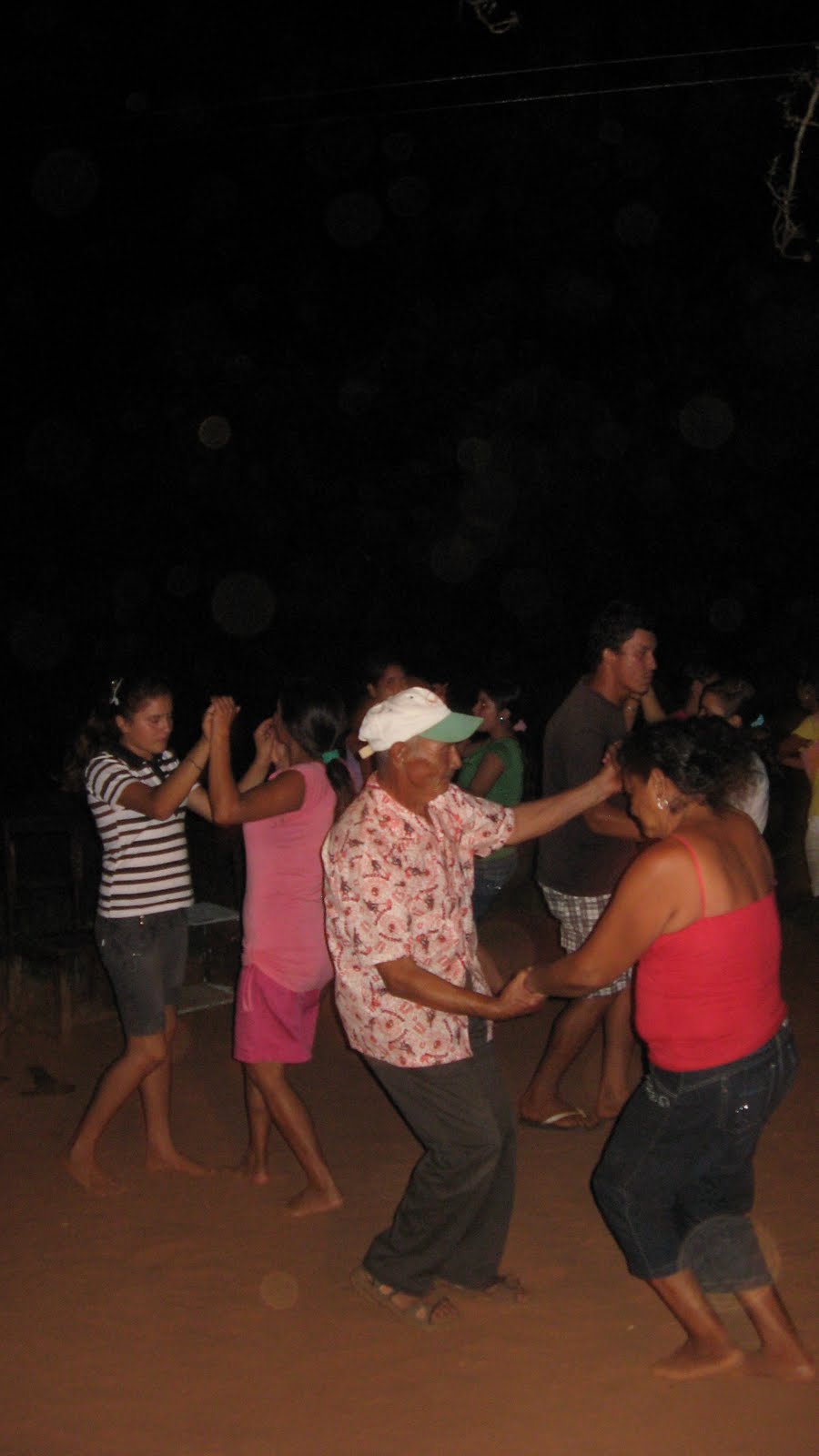
At the end of November I had two despedidas (going-away parties). One was sponsored by my farmers´committee, who killed a pig and chickens and gifted me and personalized leather terere set. My next despedida involved the whole community, or at least the people I knew. MOre grilled meat, more sopa, more dancing, and a drunken fist fight. Both of these parties were touching, but my last dinner with my favorite host family was the most emotional. My host mother, Marina, who has been a bottomless pit of support for me over the past two years, took me in her arms and told me how proud of me she was, and that I have become their daughter, sister, and friend; that I am always welcome in their family. We were all crying, even my 13-year-old host brother, Gustavo, and my shy dad.
I cried again as I watched the sun rise on the bus to the city, and many times after that. It was not only the sadness of leaving people who have become dear to me, but leaving a life that I have been blessed to experience and will probably never have again. Being a visitor to Arroyo Moroti is a definate plan, but I hold no false hopes that everything will be the same.
With these thoughts, I arrived back to Arroyo Moroti, on moto, and I felt completely welcomed and loved. I ate lunch at a different house everyday, a campo fiesta was thrown in my honor, and I felt free to enjoy the priveleges of living in Paraguay without the responsibility that came with working there. After a week, it was hard to leave a second time, as well, but now I know how easy it is to return.
My next adventures take me into the enchanted mountains of Brazil, where I am currently studying yoga. More on that later...
Wednesday, February 9, 2011
Our Just Deserts

The desert wants to keep me, and I haven´t yet decided if it´s out of love or hatred--towards me, that is. My nostrils burn from the high, dry air, and everything is covered in a fine coat of desert dust.
The first desert adventure began as Jason and I were heading north from Chile to El Bolson, a little micro-climate hippy community just south of Bariloche, Argentina. The bus treks up Route 40, which is nothing more than gravel streching through an endless desert, east of the Andes. The trip was supposed to take 25 hours, already a harrying journey on a crammed bus on bumpy roads. Halfway into the trip the bus broke down and after hours of poking, prodding, and crawling under the bus, it was deemed unfixable. As we were in the middle of the desert with no cell service (less water or food), we had to wait until someone passed us to send a message along for them to send a rescue bus...and hope that the message was transferred. We finally got word that one was on the way and would arrive in about ten hours. So we waited.
We scooped sludgy water from a questionable pit 3km down the road, and dug through my pack for the iodine tablets. The hot sun slipped below the brown horizon and left us in a bitterly cold night, and still no bus in site. We spent the night on the bus, and 24 hours later, a bus finally showed. Apparently the rescue bus had broken down, as well, and this was the third try. We arrived at our destination one hour before 2011.

The desert tried to take us again at Quebrada del Diablo, a `mountain-biker´s paradise´ outside of San Pedro de Atacama, in northern Chile. We rented bikes, lathered on sunblock, and headed out to crumbly grey rocks below a blue, cloudless sky. After crossing a river up to my shins, the sandy trail narrowed into a crude labrynth of compressed sand and clay (which is only held together because it never rains) with outcroppings, sharp corners, and a few places where we had to lift the bikes up to continue. At one point, a smaller trail led off to the right, and I parked my bike and followed it on foot. Soon the trail forked. It forked again. And again and again with no end in site. That was when I first felt the presence of this canyon´s namesake (i.e. devil). So I turned around, and we continued on our collective four wheels.
Two-and-a-half hours into the journey, my bike chain broke, and after multiple failed attempts at reconnecting it, we decided that one of us had to go on ahead for help. The map clearly markes this as a loop, but the trail was getting more sketchy, with more forks and less clarity. Plus, the sun was hot, and our water bottles were not getting any fuller. Jason started walking my bike back the way we came, and I sped ahead on his bike as fast as I could, considering my options, knowing no car or even a horse could make it through here. Images of Ralph Fiennes in `The English Patient` kept creeping into my head, him stumbling down dunes in a desheveled turban, crazed from dehydration. Perhaps it was these fantasies, but I arrived surprizingly quickly to the river, where about ten people were hanging out in the water. Jason arrived shortly after, and we got a ride back into town with a local family, disaster averted.
It has not rained in San Pedro de Atacama since 2000. It used to rain in this desert oasis more like seven days a year, but now water is scarce. The riverbed is a pile of dusty rocks, and from the top of the lookout I climbed (where the indigenous peoples held a fortress and managed to stave off for the Spaniards for a good number of years), I could see a swath of green snaking through the valley and widening at the town--the oasis, the product of a one-meter-wide canal coming from the river.

Back when it used to rain, farmers were allotted an hour each day to irrigate their corn and wheat. Now there is no wheat and little corn. Food is expensive, as you might imagine, but locals love this place and are proud of their roots, and tourists flock here from all over the world. Rightfully so. There is a lot to do here, just walking and biking distance from this tiny pueblo. We managed to go sandboarding (think snowboarding, but on sand dunes), watched the sun set over Valle de la Luna (so called because of the formations in the rock which resemble the surface of the moon), walked through ancient ruins, and watched stars through telescopes in the middle of the dark desert, where I bathed in starlight that had been travelling since the time of Colombus to get to me.
Sunday, December 26, 2010
The Beginning of a Long Series of Fortuitous Successes
The End of the World is far, far away. And it is cold, even during this supposed summer. Tierra del Fuego (Land of Fire) was so named because of the explorer, Magellan, who sailed on over from Portugal in 1520 and saw the campfires of the Yaghan native people (now pretty much extinct) dotting the coastline. It is a beautiful, yet testing region. The climate, which is described as ´inhospitable´, is unpredictable, with biting winds that suddenly surrender to warmth of the sun, only to disappear again around the next corner.

My brotherman, Jason, and I landed in Ushuaia, the world´s southern-most city, on December 14th and headed straight for el Parque Nacional de Tierra del Fuego. After some initial hurdles (i.e. arriving to the airport two days early), as soon as we found our first campsite (see photo), things seemed to be looking up. We were greeted by a pair of native geese (they stay with the same mate for life) and a bunch of wild bunnies, and we set up the tent next to winding river carrying glacial melt. It took a while just to decide which way to face the tent, as there are no shortage of beautiful views in all directions.
That first night, exhausted from the trip from Buenos Aires, we sat in the tent, sheltered from the unrelenting cold and wind, waiting for some sign of bedtime, only to realize it was already 9pm, and we still had to cook dinner. We went to sleep an hour later with no sign of approaching darkness. This is, afterall, the bottom of the world in summertime. Another night we dined with a view of the harbor at 11pm, watching the glowing pinks and purples of an eternal sunset.
After a few days of hiking around the park, we caught a bus heading north. The road hugs the Atlantic coastline, and we left the lush, jagged hills for a more arid landscape teeming with guanacos (like llamas), and crossed over into Chile´s Patagonia. Patagonia lives up to its reputation of having some of the most beautiful scenery in the world. We stayed two nights in the small town of Puerto Natales to stock up on supplies for a week-long backpacking trip in the national park of Torres del Paine.

The first day we walked 20km to the first campsite, a meadow covered in daisies and nestled up against snow-littered mountains. But even these huge mountains were no respite from the fickle winds. The weather in general here is unpredictable, to say the least. Locals laugh when asked about the forecast. They look up at the sky and say something like, ¨Well, it´s raining now.¨ Now is all we can really know.
Our route was a circuit that guided us over ridges and through valleys, circling huge enormous granite towers, which are the park´s centerpiece. Walking towards them in the sun that first day, they looked majestic and grand—the Emerald City tured brown. But the winds change around every ridge. One minute it´s hot and sunny, and the next the rain spits and the wind threatens to blow you off the trail and down the ravine into the iceberg-ridden lake below. When the fog lifts enough to see the towers, they look evil an morbid, resembling the residence of the Wicked Witch of the West.

The winds started up the first night, pushing the tent down on top of us. I lay in my sleeping bag, not sleeping, listening to the wildness outside,and finally getting up the nerve to go pee. The nearly-full moon was behind a cloud, but still lighting up the sky and making the daisies glow earily.
The next morning we packed up our bags in the rain and walked 19km in a continuous downpour. When we finally arrived and set up the tent, I found that ´waterproof´ does not really exist, and that everything—icluding the tent and my sleeping—was soaked. Very luckily, at that location there happened to be a refugio, a little cabin with a woodstove and bunkbeds for a fee. After chatting with a Spanish woman who was victim to the same, wet fate, I decided to stay in the cabin that night, instead of toughing it out in the tent, like Jason. I sat around the woodstove with fellow hikers from the US, England, New Zealand, Spain, Italy, and Chile. We formed a good little group, leapfrogging each other on the trail the entire week.
I received a wonderful gift of two garbage bags, in which I placed all my belongings before putting them inside my pack. We headed out anew that Solstice morning, with mostly-clear skies and the longest day of the year (and probably my life) ahead of us. When we climbed above the treeline, the wind was unbelievable; Jason guessed it was blowing about 80mph. I would steady myself and my pack against it, and then all of a sudden it would gust up and literally knock me down. During these gusts all I could do was surrender to it and remain on the ground long enough to catch my breath.
The next few days took us trudging up steep, snowy slopes and crossing a peak to finally give us a view of Glacier Grey, an enormous mass of ice that, during this warmer season, drops house-size chunks of itself into the crystal, blue lake below. We trudged through the mud, frolicked through fields of wildflowers, and hopped on rocks across frigid streams. At one of our last campsites we looked up from setting up the tent to see an avalanche screaming down the mountain on the other side of the river from us. Glaciers and avalanches exist on the news or in National Geographic; I never imagined I would actually see (and hear) them.

We spent Christmas Eve huddled inside the tent, feasting on instant mashed potatoes and Ramen noodles, and decided that we deserved a real Christmas meal. So, despite aching muscles and blistered feet (my toes and heals were covered in duct tape), we woke up early, completed the park circuit, and caught a bus back into civilization for some well-deserved skyping, ice-cream, wine, salmon, and dancing (in that order).
We just dropped off 7 kilos of dirty laundry at the laundromat in preparation for the continued journey north. Tuesday we head to the Fitz Roy Mountains in the southern Andes for some day hikes. To the North!
My brotherman, Jason, and I landed in Ushuaia, the world´s southern-most city, on December 14th and headed straight for el Parque Nacional de Tierra del Fuego. After some initial hurdles (i.e. arriving to the airport two days early), as soon as we found our first campsite (see photo), things seemed to be looking up. We were greeted by a pair of native geese (they stay with the same mate for life) and a bunch of wild bunnies, and we set up the tent next to winding river carrying glacial melt. It took a while just to decide which way to face the tent, as there are no shortage of beautiful views in all directions.
That first night, exhausted from the trip from Buenos Aires, we sat in the tent, sheltered from the unrelenting cold and wind, waiting for some sign of bedtime, only to realize it was already 9pm, and we still had to cook dinner. We went to sleep an hour later with no sign of approaching darkness. This is, afterall, the bottom of the world in summertime. Another night we dined with a view of the harbor at 11pm, watching the glowing pinks and purples of an eternal sunset.
After a few days of hiking around the park, we caught a bus heading north. The road hugs the Atlantic coastline, and we left the lush, jagged hills for a more arid landscape teeming with guanacos (like llamas), and crossed over into Chile´s Patagonia. Patagonia lives up to its reputation of having some of the most beautiful scenery in the world. We stayed two nights in the small town of Puerto Natales to stock up on supplies for a week-long backpacking trip in the national park of Torres del Paine.
The first day we walked 20km to the first campsite, a meadow covered in daisies and nestled up against snow-littered mountains. But even these huge mountains were no respite from the fickle winds. The weather in general here is unpredictable, to say the least. Locals laugh when asked about the forecast. They look up at the sky and say something like, ¨Well, it´s raining now.¨ Now is all we can really know.
Our route was a circuit that guided us over ridges and through valleys, circling huge enormous granite towers, which are the park´s centerpiece. Walking towards them in the sun that first day, they looked majestic and grand—the Emerald City tured brown. But the winds change around every ridge. One minute it´s hot and sunny, and the next the rain spits and the wind threatens to blow you off the trail and down the ravine into the iceberg-ridden lake below. When the fog lifts enough to see the towers, they look evil an morbid, resembling the residence of the Wicked Witch of the West.
The winds started up the first night, pushing the tent down on top of us. I lay in my sleeping bag, not sleeping, listening to the wildness outside,and finally getting up the nerve to go pee. The nearly-full moon was behind a cloud, but still lighting up the sky and making the daisies glow earily.
The next morning we packed up our bags in the rain and walked 19km in a continuous downpour. When we finally arrived and set up the tent, I found that ´waterproof´ does not really exist, and that everything—icluding the tent and my sleeping—was soaked. Very luckily, at that location there happened to be a refugio, a little cabin with a woodstove and bunkbeds for a fee. After chatting with a Spanish woman who was victim to the same, wet fate, I decided to stay in the cabin that night, instead of toughing it out in the tent, like Jason. I sat around the woodstove with fellow hikers from the US, England, New Zealand, Spain, Italy, and Chile. We formed a good little group, leapfrogging each other on the trail the entire week.
I received a wonderful gift of two garbage bags, in which I placed all my belongings before putting them inside my pack. We headed out anew that Solstice morning, with mostly-clear skies and the longest day of the year (and probably my life) ahead of us. When we climbed above the treeline, the wind was unbelievable; Jason guessed it was blowing about 80mph. I would steady myself and my pack against it, and then all of a sudden it would gust up and literally knock me down. During these gusts all I could do was surrender to it and remain on the ground long enough to catch my breath.
The next few days took us trudging up steep, snowy slopes and crossing a peak to finally give us a view of Glacier Grey, an enormous mass of ice that, during this warmer season, drops house-size chunks of itself into the crystal, blue lake below. We trudged through the mud, frolicked through fields of wildflowers, and hopped on rocks across frigid streams. At one of our last campsites we looked up from setting up the tent to see an avalanche screaming down the mountain on the other side of the river from us. Glaciers and avalanches exist on the news or in National Geographic; I never imagined I would actually see (and hear) them.
We spent Christmas Eve huddled inside the tent, feasting on instant mashed potatoes and Ramen noodles, and decided that we deserved a real Christmas meal. So, despite aching muscles and blistered feet (my toes and heals were covered in duct tape), we woke up early, completed the park circuit, and caught a bus back into civilization for some well-deserved skyping, ice-cream, wine, salmon, and dancing (in that order).
We just dropped off 7 kilos of dirty laundry at the laundromat in preparation for the continued journey north. Tuesday we head to the Fitz Roy Mountains in the southern Andes for some day hikes. To the North!
Subscribe to:
Posts (Atom)